
Understanding how we think and draw conclusions is essential in both everyday life and academic fields.
Two fundamental reasoning methods are Inductive Reasoning and Deductive Reasoning. While they may seem similar, they work in very different ways.
In this guide, we’ll break down induction vs deduction in simple terms, provide clear examples, and help you understand when to use each method effectively.
What Is Inductive Reasoning?
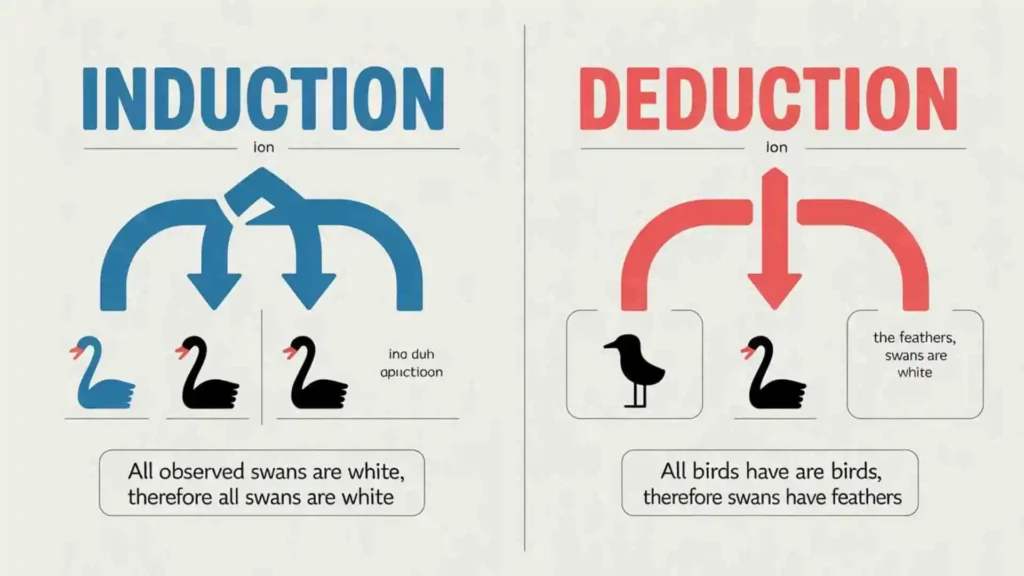
Inductive reasoning involves making general conclusions based on specific observations.
Key Characteristics:
- Starts with specific examples
- Moves toward a general conclusion
- Conclusions are probable, not certain
Example:
- Every swan I’ve seen is white
- Therefore, all swans are white
This method is commonly used in science to form hypotheses.
What Is Deductive Reasoning?
Deductive reasoning works the opposite way—it starts with a general rule and applies it to specific cases.
Key Characteristics:
- Starts with a general statement
- Moves to a specific conclusion
- Conclusions are logically certain (if premises are true)
Example:
- All humans are mortal
- John is a human
- Therefore, John is mortal
Key Differences Between Induction and Deduction
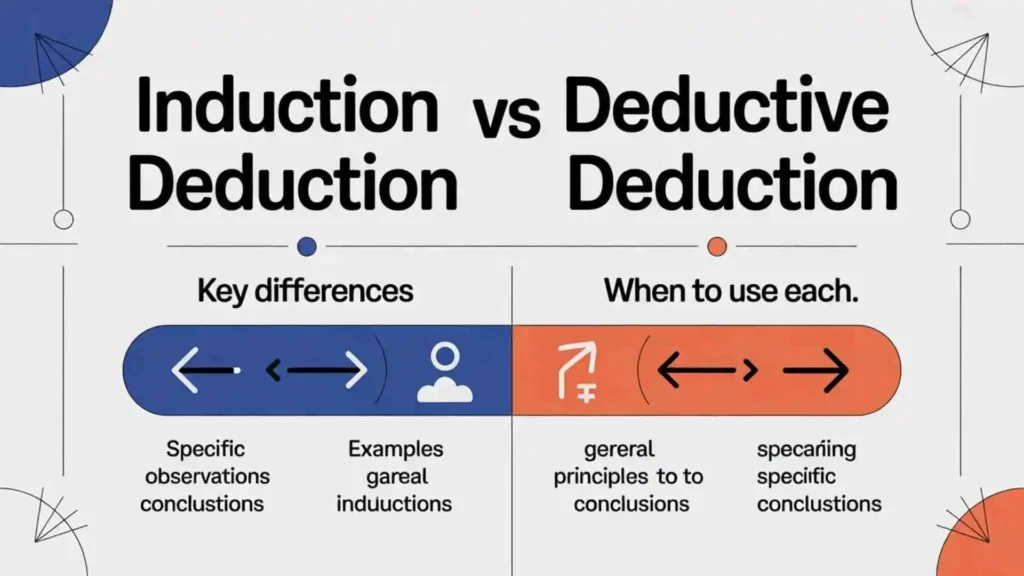
| Feature | Inductive Reasoning | Deductive Reasoning |
| Direction | Specific → General | General → Specific |
| Certainty | Probable | Certain |
| Usage | Forming theories | Testing theories |
Real-Life Examples
Inductive Reasoning:
- Observing customer behavior to predict trends
- Noticing patterns in weather
Deductive Reasoning:
- Solving math problems
- Applying rules in law or logic
Advantages and Limitations
Inductive Reasoning
Pros:
- Encourages discovery
- Useful for predictions
Cons:
- Not always accurate
- Based on limited data
Deductive Reasoning
Pros:
- Highly reliable
- Clear logical structure
Cons:
- Depends on correct premises
- Less flexible
When to Use Induction vs Deduction
- Use inductive reasoning when exploring new ideas or forming hypotheses
- Use deductive reasoning when testing theories or applying known rules
Applications in Daily Life and Science
- Scientists use induction to develop theories and deduction to test them
- Businesses use induction to understand trends and deduction for decision-making
- Students use both in problem-solving and critical thinking
FAQs
Which is better: induction or deduction?
Neither is better—they serve different purposes.
Is inductive reasoning always wrong?
No, it’s useful but not always certain.
Can both methods be used together?
Yes, they often complement each other.
Conclusion
The debate of induction vs deduction isn’t about which is better—it’s about understanding how each method works and when to use it.
Inductive reasoning helps you explore patterns and form ideas, while deductive reasoning allows you to test those ideas with certainty.
Together, they form the foundation of logical thinking, scientific discovery, and everyday decision-making.
Also Check These Posts
- Lidl vs Aldi Which Discount Supermarket Is Better in 2026?
- Methadone vs Suboxone Which Treatment Is Better for Opioid Recovery for 2026

Daniel Brooks
Daniel Brooks is a passionate writer and grammar enthusiast who has spent years exploring the nuances of the English language. Ever since childhood, he has been fascinated by how words shape thoughts and communication. Daniel loves breaking down complex grammar rules into simple, easy-to-understand tips that anyone can apply. His mission is to help learners, writers, and students gain confidence in their writing skills. When he’s not writing, he enjoys reading classic literature and experimenting with creative writing. Daniel believes that mastering grammar is not just about rules, but about expressing yourself clearly and effectively.
Books by Daniel Brooks:
-
The Grammar Guide: Master English with Ease
-
Writing Made Simple: Tips for Clear Communication