Understanding how your business tracks income and expenses is essential for making smart financial decisions.
Two of the most common methods are Cash Accounting and Accrual Accounting. While both serve the same purpose, they differ significantly in how and when transactions are recorded.
In this guide, we’ll break down cash vs accrual accounting in simple terms so you can choose the best method for your business.
What Is Cash Accounting?
Cash accounting records transactions only when money changes hands.
How It Works:
- Revenue is recorded when cash is received
- Expenses are recorded when cash is paid
Example:
If you send an invoice in January but get paid in February, the income is recorded in February.
Best For:
- Small businesses
- Freelancers
- Simple financial tracking
What Is Accrual Accounting?
Accrual accounting records transactions when they are earned or incurred, regardless of cash flow.
How It Works:
- Revenue is recorded when earned
- Expenses are recorded when incurred
Example:
If you complete a project in January but receive payment in February, the income is recorded in January.
Best For:
- Larger businesses
- Companies with inventory
- Businesses needing detailed financial insights
Key Differences Between Cash and Accrual Accounting
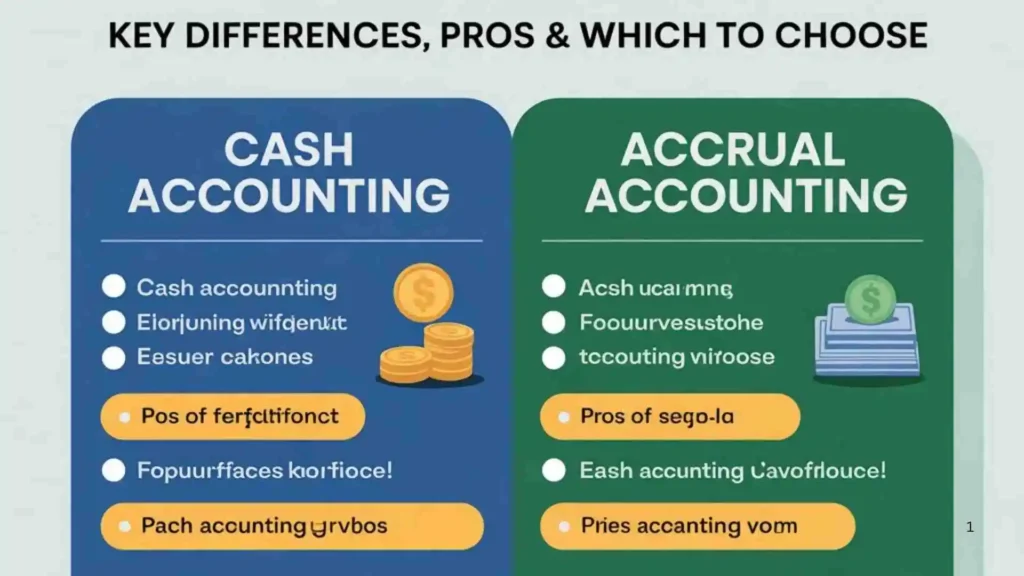
| Feature | Cash Accounting | Accrual Accounting |
| Revenue timing | When cash is received | When earned |
| Expense timing | When paid | When incurred |
| Complexity | Simple | More complex |
| Financial accuracy | Limited | More accurate |
Real-Life Examples
- Cash Method: A freelancer tracks income only after receiving payment
- Accrual Method: A company records sales immediately after delivering products
This difference can significantly impact how profits appear on financial statements.
Advantages and Disadvantages of Cash Accounting
Advantages
- Simple and easy to use
- Clear cash flow tracking
- Less paperwork
Disadvantages
- Less accurate financial picture
- Not suitable for large businesses
Advantages and Disadvantages of Accrual Accounting
Advantages
- More accurate financial reporting
- Matches income with expenses
- Required for many larger businesses
Disadvantages
- More complex
- Requires careful tracking
Which Method Is Better for Small Businesses?
- Cash accounting is ideal for small businesses with simple transactions
- Accrual accounting is better for growing businesses needing deeper insights
The right choice depends on your business size and goals.
Tax Implications
- Cash method allows you to control when income is recognized, which may help with tax planning
- Accrual method provides a clearer long-term financial view but less flexibility in timing
Always consult a tax professional before choosing a method.
When Should You Switch Methods?
You may need to switch if:
- Your business grows significantly
- You start carrying inventory
- Regulations require accrual accounting
FAQs
Is cash or accrual accounting better?
It depends on your business size and needs.
Do small businesses have to use accrual accounting?
Not always—many can use cash accounting.
Why is accrual accounting more accurate?
Because it matches income and expenses in the same period.
Conclusion
When comparing cash vs accrual accounting, the main difference lies in timing—when income and expenses are recorded.
Cash accounting offers simplicity and ease, making it ideal for small businesses, while accrual accounting provides a more accurate financial picture for growing or complex operations.
Choosing the right method depends on your business needs, financial goals, and reporting requirements.
Also Check These Posts
- Tonal vs Mirror Features Price Workouts & Which Home Gym Is Better in 2026
- RR vs LSG Head-to-Head Stats Key Players & Match Prediction in 2026

Daniel Brooks
Daniel Brooks is a passionate writer and grammar enthusiast who has spent years exploring the nuances of the English language. Ever since childhood, he has been fascinated by how words shape thoughts and communication. Daniel loves breaking down complex grammar rules into simple, easy-to-understand tips that anyone can apply. His mission is to help learners, writers, and students gain confidence in their writing skills. When he’s not writing, he enjoys reading classic literature and experimenting with creative writing. Daniel believes that mastering grammar is not just about rules, but about expressing yourself clearly and effectively.
Books by Daniel Brooks:
-
The Grammar Guide: Master English with Ease
-
Writing Made Simple: Tips for Clear Communication