The debate around Catholic vs Orthodox Christianity has existed for nearly a thousand years.
While both traditions share the same early Christian roots, they developed distinct leadership structures, theological interpretations, and worship practices.
Many people wonder what caused the split and what truly separates these two ancient branches of Christianity.
In this guide, we’ll explore their history, beliefs, similarities, and key differences in a clear and respectful way.
Overview of Catholic and Orthodox Christianity
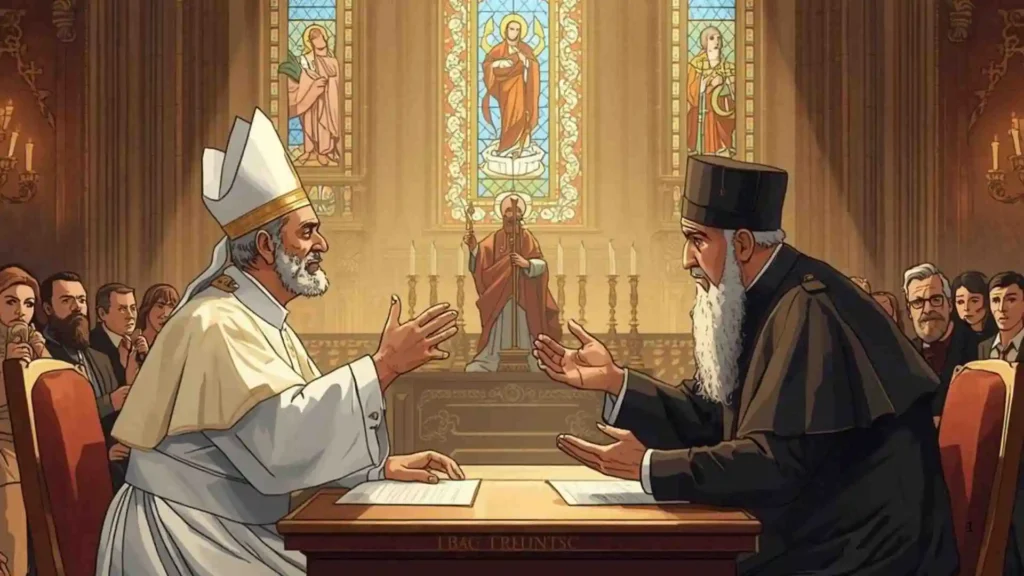
Catholic Church and Eastern Orthodox Church both trace their origins back to the early Christian communities founded by the apostles.
For the first 1,000 years of Christianity, these communities were united. They shared:
- Apostolic succession
- The same sacraments
- Early church councils
- Core Christian doctrines
The separation came later due to growing political and theological tensions.
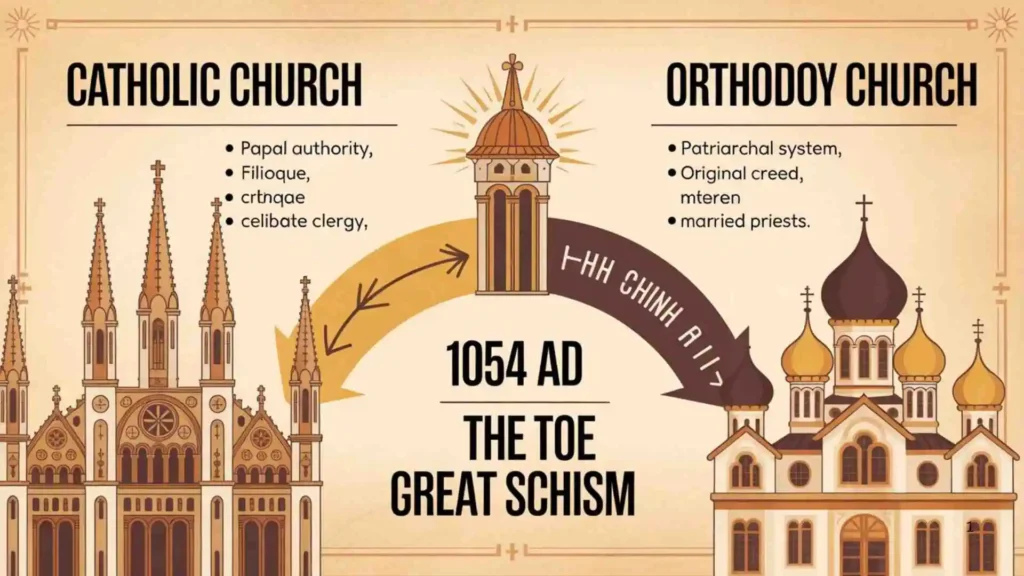
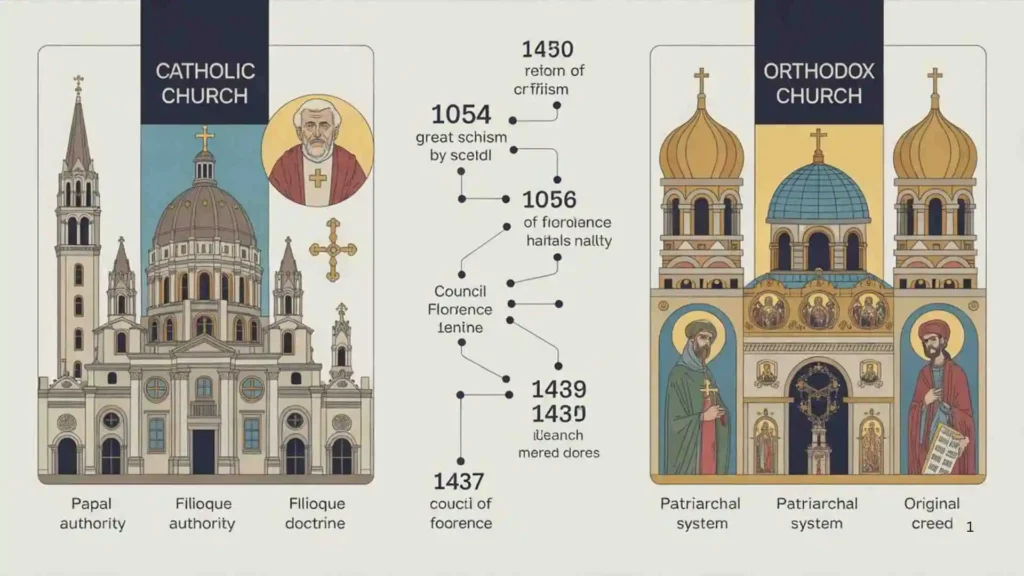
The Great Schism of 1054
The formal division between East and West is known as the Great Schism.
Main Causes:
- Disagreement over papal authority
- The “Filioque” clause in the Nicene Creed
- Cultural and political differences between Rome and Constantinople
In 1054, mutual excommunications marked the official split between the Roman Catholic Church and the Eastern Orthodox Church.
Authority and Church Leadership
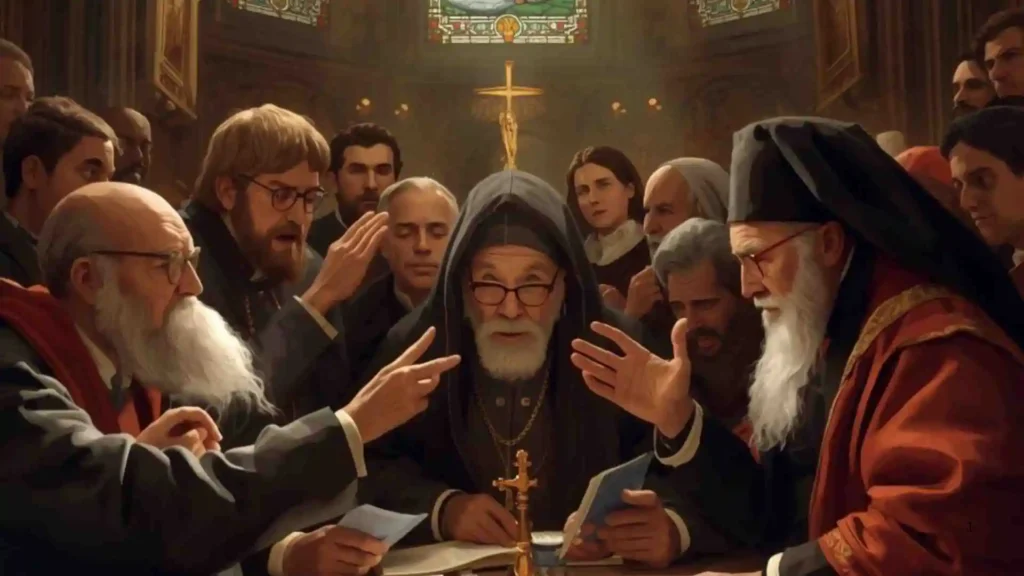
One of the biggest differences in the Catholic vs Orthodox debate is leadership.
Catholic Church
- Led by the Pope (Bishop of Rome)
- Centralized authority
- Belief in papal infallibility (under specific conditions)
Orthodox Church
- Governed by a group of Patriarchs
- No single supreme leader
- Emphasis on conciliar authority (church councils)
This difference in authority remains one of the most important distinctions today.
Key Theological Differences
1. The Filioque Clause
Catholics include “and the Son” in describing the procession of the Holy Spirit. Orthodox Christians reject this addition.
2. Papal Infallibility
Catholics believe the Pope can speak infallibly on matters of faith under defined conditions. Orthodox Christians do not accept this doctrine.
3. Original Sin
Both believe in inherited sin, but Orthodox theology emphasizes ancestral sin differently than Western interpretations.
Worship and Liturgy
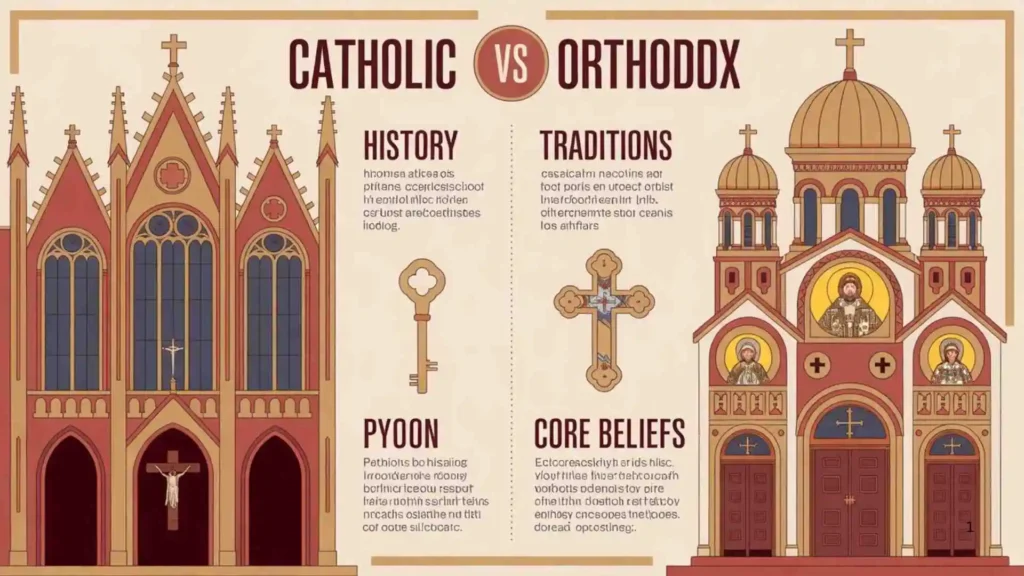
Catholic Worship
- The Mass
- Can be traditional Latin or local language
- Less use of icons compared to Orthodoxy
Orthodox Worship
- Divine Liturgy (often of St. John Chrysostom)
- Heavy use of icons
- Ancient chants and symbolic rituals
Orthodox liturgy tends to emphasize mysticism and continuity with early Christian tradition.
Sacraments Comparison
Both churches recognize seven sacraments:
- Baptism
- Eucharist
- Confirmation/Chrismation
- Confession
- Marriage
- Holy Orders
- Anointing of the Sick
However, how they administer and explain them can vary slightly.
Cultural and Geographic Influence
- Catholicism is widespread in Europe, the Americas, and parts of Africa and Asia.
- Orthodox Christianity is strongest in Eastern Europe, Russia, and parts of the Middle East.
Both traditions have deeply influenced global culture, art, and theology.
Similarities Between Catholic and Orthodox
Despite differences, they share:
- Apostolic succession
- Veneration of saints
- Belief in the Trinity
- The Nicene Creed
- The seven sacraments
The foundation of faith remains remarkably similar.
Which Is Older?
Both traditions originate from the same early Christian Church. Neither is “older” — they were united before the 1054 split.
Quick Comparison Table
| Topic | Catholic | Orthodox |
| Leader | Pope | Patriarchs |
| Authority | Centralized | Council-based |
| Filioque | Included | Rejected |
| Worship Style | Structured, varied | Mystical, icon-focused |
| Origin | Western Europe | Eastern Europe |
Conclusion
The Catholic vs Orthodox discussion is rooted in nearly 1,000 years of history.
While theological and leadership differences remain significant, both churches share deep apostolic foundations and many core Christian beliefs.
Understanding their distinctions helps foster respect and clarity rather than division. If exploring faith historically or spiritually, both traditions represent rich and ancient expressions of Christianity.
Also Check These Posts
- LED vs Incandescent Which Light Bulb Is Better in 2026
- Methocarbamol vs Cyclobenzaprine Which Muscle Relaxer Is Better for 2026

Sophia Miller
Hi, I’m Sophia Miller, a passionate language enthusiast and grammar lover. Ever since I was a child, I’ve been fascinated by the power of words and how proper grammar can transform communication. I’ve spent years exploring the intricacies of English, from punctuation quirks to sentence structures, and I love helping others master the art of writing clearly and confidently. Writing, teaching, and sharing tips has always been my way of connecting with fellow language lovers. When I’m not analyzing sentences, you’ll find me reading novels or sipping coffee while jotting down new ideas. Grammar isn’t just rules to me—it’s a way to express creativity with precision.
Books by Sophia Miller:
-
Mastering English Grammar Made Easy
-
The Writer’s Guide to Perfect Sentences