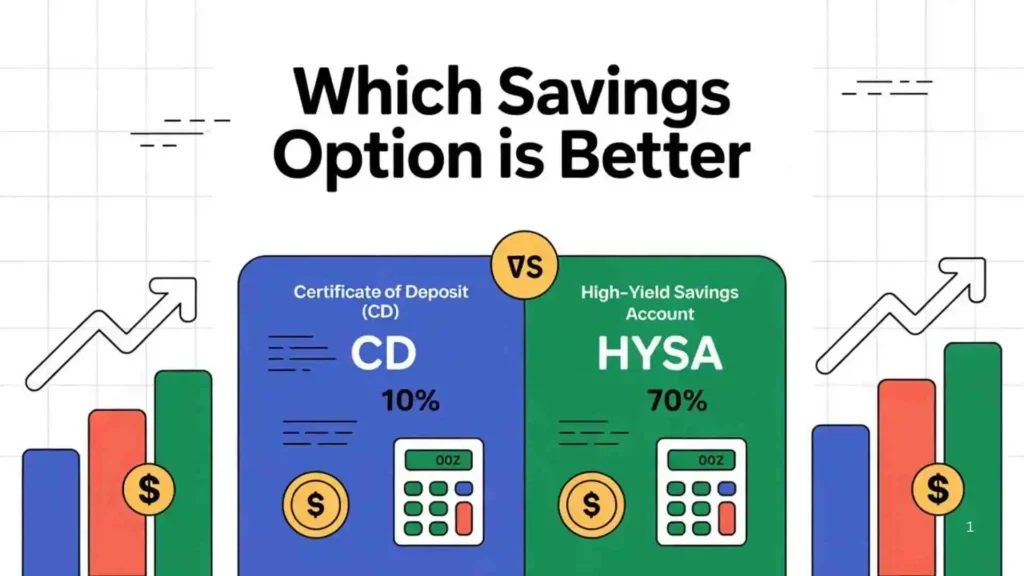
When it comes to saving money, many people compare CD vs HYSA to find the best option for their financial goals.
Both are safe and reliable ways to grow your savings, but they work very differently. A CD locks your money for a fixed time, while a HYSA offers flexibility and easy access.
Understanding the differences between a Certificate of Deposit and a High-Yield Savings Account can help you make smarter financial decisions.
If you want higher returns or more flexibility, choosing the right option depends on your needs.
What Is a CD (Certificate of Deposit)?
A CD is a savings product where you deposit money for a fixed period, such as 6 months, 1 year, or longer.
Key features include:
- Fixed interest rate
- Locked investment period
- Penalty for early withdrawal
CDs are ideal for people who want guaranteed returns and don’t need immediate access to their funds.
What Is a HYSA (High-Yield Savings Account)?
A HYSA is a savings account that offers higher interest rates than traditional savings accounts.
Key features include:
- Flexible deposits and withdrawals
- Variable interest rates
- Easy access to funds
HYSAs are suitable for people who want to save money while keeping it accessible.
CD vs HYSA: Key Differences Explained
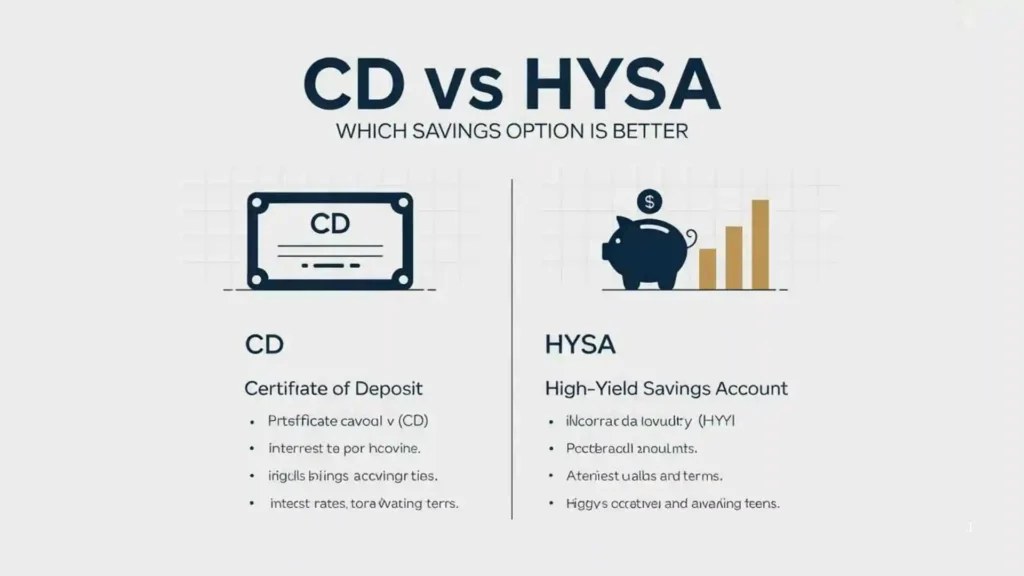
Interest Rates
CDs usually offer fixed interest rates, which means your return is guaranteed. HYSAs offer variable rates that may change over time.
Liquidity
HYSAs provide high liquidity, allowing you to withdraw money anytime. CDs restrict access until the maturity date.
Risk and Safety
Both CDs and HYSAs are considered safe, especially when offered by insured banks. Your money remains protected with minimal risk.
Flexibility
HYSAs are more flexible, while CDs require commitment for a specific time period.
Pros and Cons of CDs
Pros
- Guaranteed returns
- Fixed interest rates
- Low risk
Cons
- Limited access to funds
- Early withdrawal penalties
- Less flexibility
Pros and Cons of HYSAs
Pros
- Easy access to money
- Competitive interest rates
- Flexible savings
Cons
- Variable interest rates
- Lower returns compared to long-term CDs
When Should You Choose a CD?
Choose a CD if:
- You don’t need immediate access to your money
- You want stable and predictable returns
- You are saving for a future goal
When Should You Choose a HYSA?
Choose a HYSA if:
- You need quick access to your savings
- You want flexibility
- You are building an emergency fund
CD vs HYSA Comparison Table
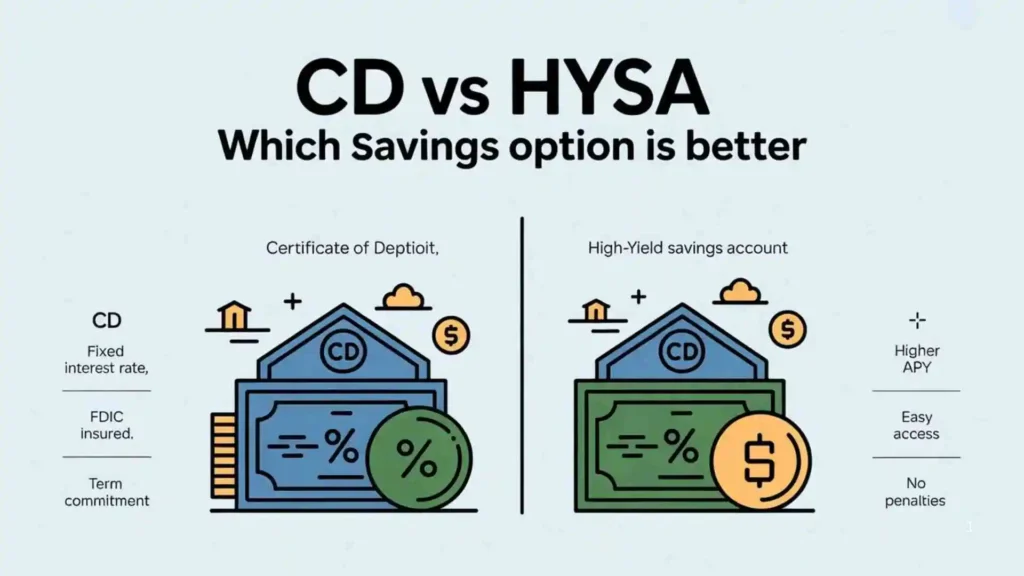
| Feature | CD | HYSA |
| Interest Rate | Fixed | Variable |
| Access to Funds | Limited | Easy |
| Risk | Low | Low |
| Flexibility | Low | High |
FAQs
Which is better, CD or HYSA?
It depends on your needs. CDs offer higher fixed returns, while HYSAs provide flexibility and easy access.
Can I lose money in a CD or HYSA?
Both are low-risk options. Your money is generally safe if held in insured financial institutions.
Are CD rates higher than HYSA?
Often yes, especially for longer-term CDs. However, HYSA rates can still be competitive.
Is a HYSA good for emergency funds?
Yes, HYSAs are ideal because you can access your money quickly when needed.
Conclusion
The CD vs HYSA comparison shows that both options have unique advantages. CDs are perfect for stable, long-term savings, while HYSAs offer flexibility and easy access to funds.
Choosing the right option depends on your financial goals, timeline, and need for liquidity.
By understanding these differences, you can make smarter decisions and grow your savings with confidence.
Also Check These Posts
- Jazz vs 76ers Game Preview Head-to-Head Stats Key Players & Prediction in 2026
- MX vs ATV | Which Off-Road Ride Is Right for You for 2026

Emma Johnson
Hi! I’m Emma Johnson, a passionate writer and grammar enthusiast who loves exploring the magic of words. For as long as I can remember, I’ve been fascinated by how language shapes ideas and connects people. Through my writing, I aim to make grammar simple, fun, and accessible for everyone. I enjoy sharing tips, tricks, and little-known rules that help readers improve their writing confidently. When I’m not writing, you’ll usually find me reading classic novels, journaling, or sipping coffee while brainstorming new ideas. Writing is not just my profession—it’s my way of inspiring others to express themselves clearly and creatively.
Books by Emma Johnson:
-
Grammar Made Simple
-
Mastering English Essentials