
Confused about either vs neither? You’re definitely not alone—these two small words cause big grammar mix-ups for many English learners and writers.
If you’ve ever paused mid-sentence wondering which one fits, this guide is here to help.
We’ll break down the meanings, show clear examples, and share easy tips to remember the difference.
By the end, you’ll feel confident using either and neither in everyday conversations, emails, and writing.
What Does “Either” Mean?
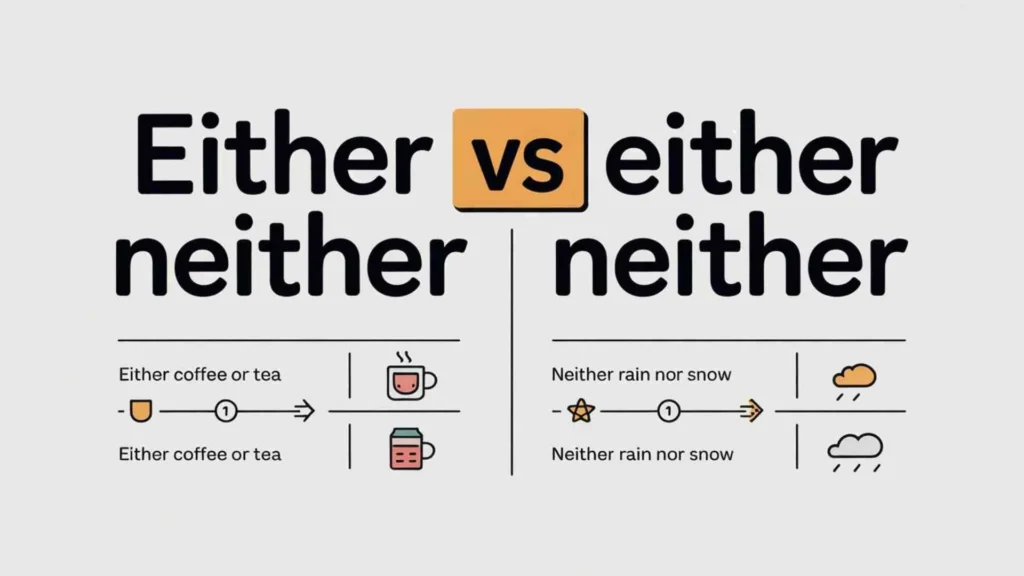
Either refers to one of two choices. It’s usually used in positive sentences or when offering options.
Examples:
✅ You can choose either dress.
✅ Either answer is fine.
Think of either as meaning one or the other.
What Does “Neither” Mean?
Neither means not one and not the other. It’s used to reject both options.
Examples:
✅ Neither option works for me.
✅ Neither student passed the test.
So, neither = zero out of two.
Either vs Neither: Key Differences
Here’s the core difference:
- Either → one of two (positive choice)
- Neither → none of two (negative meaning)
In simple terms:
👉 Either picks one.
👉 Neither rejects both.
How to Use Either in a Sentence
You can use either in several ways:
As a determiner
✅ Either road will take you there.
With “or”
✅ You can have either tea or coffee.
In negative sentences (informal usage)
✅ I don’t like it either.
How to Use Neither in a Sentence
Neither often appears with nor:
✅ Neither John nor Sarah is coming.
It can also stand alone:
✅ Neither is correct.
Important grammar tip: Neither is treated as singular.
Common Grammar Mistakes to Avoid
❌ Using either when you mean none
❌ Forgetting that neither is singular
❌ Mixing neither with “or” instead of “nor”
❌ Double negatives like: I don’t like neither
Correct version:
✅ I like neither.
Easy Memory Trick
Try this:
👉 Either = E = Each (one choice)
👉 Neither = N = None
This tiny trick makes it much easier to remember.
Quick Comparison Table
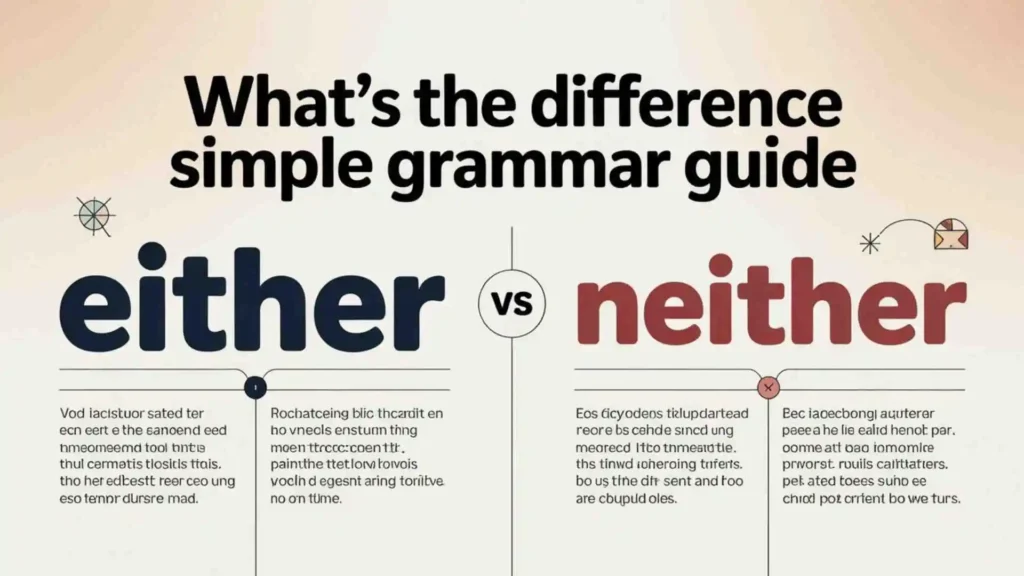
| Word | Meaning | Used For |
| Either | One of two | Positive choice |
| Neither | None of two | Negative meaning |
✅ Conclusion
Understanding either vs neither is easier once you remember the basic rule: either chooses one, neither chooses none.
With a little practice and the examples above, you’ll be able to use both words confidently in writing and conversation.
Small grammar improvements like this can make your English clearer and more professional.

Emma Johnson
Hi! I’m Emma Johnson, a passionate writer and grammar enthusiast who loves exploring the magic of words. For as long as I can remember, I’ve been fascinated by how language shapes ideas and connects people. Through my writing, I aim to make grammar simple, fun, and accessible for everyone. I enjoy sharing tips, tricks, and little-known rules that help readers improve their writing confidently. When I’m not writing, you’ll usually find me reading classic novels, journaling, or sipping coffee while brainstorming new ideas. Writing is not just my profession—it’s my way of inspiring others to express themselves clearly and creatively.
Books by Emma Johnson:
-
Grammar Made Simple
-
Mastering English Essentials

