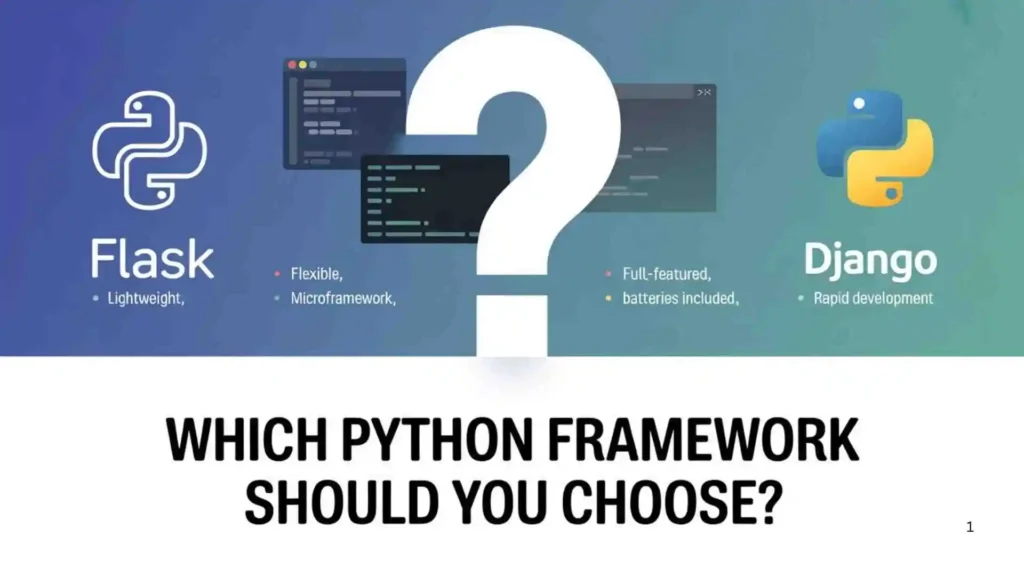
Choosing between Flask vs Django can feel overwhelming, especially if you’re starting your web development journey.
Both are powerful Python web frameworks, but they serve different purposes and project needs. Flask offers flexibility and simplicity, while Django provides a full-featured, ready-to-use solution.
Understanding their differences in performance, scalability, security, and ease of use will help you make the right decision. Let’s break everything down in clear and simple terms.
What Is Flask?
Flask is a lightweight Python microframework designed for simplicity and flexibility.
Key characteristics:
- Minimal core
- No built-in database or authentication system
- Highly customizable
Flask gives developers full control over project structure and components. It is ideal for small to medium applications or APIs.
What Is Django?
Django is a high-level full-stack Python framework designed for rapid development and clean design.
Key characteristics:
- Built-in admin panel
- ORM (Object Relational Mapper)
- Authentication system
- Security features included
Django follows the “batteries-included” philosophy, meaning it provides almost everything out of the box.
Core Philosophy: Microframework vs Full-Stack
The biggest difference between Flask and Django is their philosophy.
- Flask = Minimal and flexible
- Django = Structured and feature-rich
Flask allows you to choose your tools.
Django gives you a complete toolkit immediately.
Flask vs Django: Feature Comparison
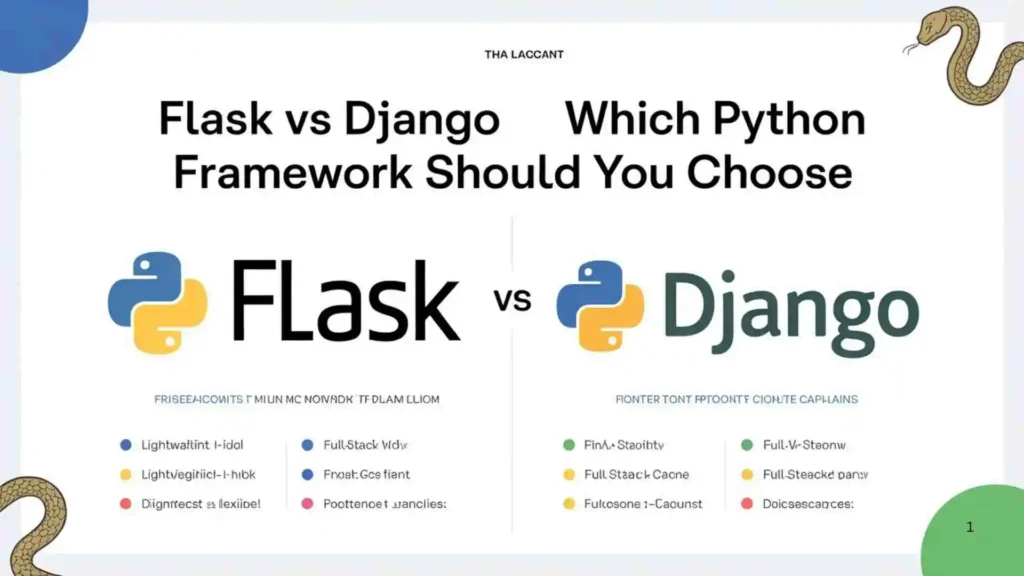
| Feature | Flask | Django |
| Type | Microframework | Full-stack framework |
| Built-in Admin | No | Yes |
| ORM | Optional | Included |
| Authentication | Manual setup | Built-in |
| Flexibility | High | Moderate |
| Learning Curve | Easier initially | Slightly steeper |
Performance Comparison
In basic applications:
- Flask can feel faster because it’s lightweight.
- Django handles heavy, complex applications efficiently.
For most real-world apps, performance differences are minimal and depend more on architecture than framework choice.
Scalability Differences
Django is designed with scalability in mind. Large platforms like Instagram use Django for backend systems.
Flask can also scale well but requires more manual configuration and planning.
If you’re building:
- Enterprise applications → Django
- Lightweight APIs → Flask
Ease of Learning
Flask is often recommended for beginners because:
- It has fewer built-in rules
- Simple project structure
- Easier to understand basics
Django has more built-in features, which can feel overwhelming at first but saves time later.
Security Features
Django includes built-in protection against:
- SQL injection
- Cross-site scripting (XSS)
- Cross-site request forgery (CSRF)
Flask requires you to implement many security measures manually.
If security is a top priority, Django offers stronger default protection.
When Should You Choose Flask?
Choose Flask if:
- You want maximum flexibility
- You’re building a REST API
- You prefer customizing every component
- You’re creating a small project
Flask works great for microservices and start ups testing MVPs.
When Should You Choose Django?
Choose Django if:
- You need built-in authentication
- You want fast development
- You’re building large-scale applications
- You want strong security features
Django is excellent for content-heavy websites and enterprise systems.
Community and Ecosystem
Both frameworks have strong communities.
Django:
- Older
- Larger ecosystem
- Extensive documentation
Flask:
- Active community
- Flexible extensions
- Growing popularity
Both are stable and widely supported.
Final Verdict
The Flask vs Django decision depends on your project needs and development style. Flask offers flexibility and simplicity, making it perfect for small apps and APIs.
Django provides a complete framework with built-in tools, ideal for large, scalable web applications. There is no “one-size-fits-all” answer the best framework is the one that matches your goals.
Conclusion
When comparing Flask vs Django, think about project size, scalability, security, and development speed.
Flask gives you control and simplicity, while Django offers structure and built-in power. Both frameworks are excellent choices in the Python ecosystem.
Evaluate your project requirements carefully, and you’ll confidently choose the right tool for your web development journey.
Also Check These Posts
- Methadone vs Suboxone Which Treatment Is Better for Opioid Recovery for 2026
- Inter vs Liverpool Team Form Key Battles and Match Expectations for 2026

Emma Johnson
Hi! I’m Emma Johnson, a passionate writer and grammar enthusiast who loves exploring the magic of words. For as long as I can remember, I’ve been fascinated by how language shapes ideas and connects people. Through my writing, I aim to make grammar simple, fun, and accessible for everyone. I enjoy sharing tips, tricks, and little-known rules that help readers improve their writing confidently. When I’m not writing, you’ll usually find me reading classic novels, journaling, or sipping coffee while brainstorming new ideas. Writing is not just my profession—it’s my way of inspiring others to express themselves clearly and creatively.
Books by Emma Johnson:
-
Grammar Made Simple
-
Mastering English Essentials