When comparing JavaScript and Java, many beginners assume they are similar because of their names.
However, they are completely different programming languages with unique purposes and features.
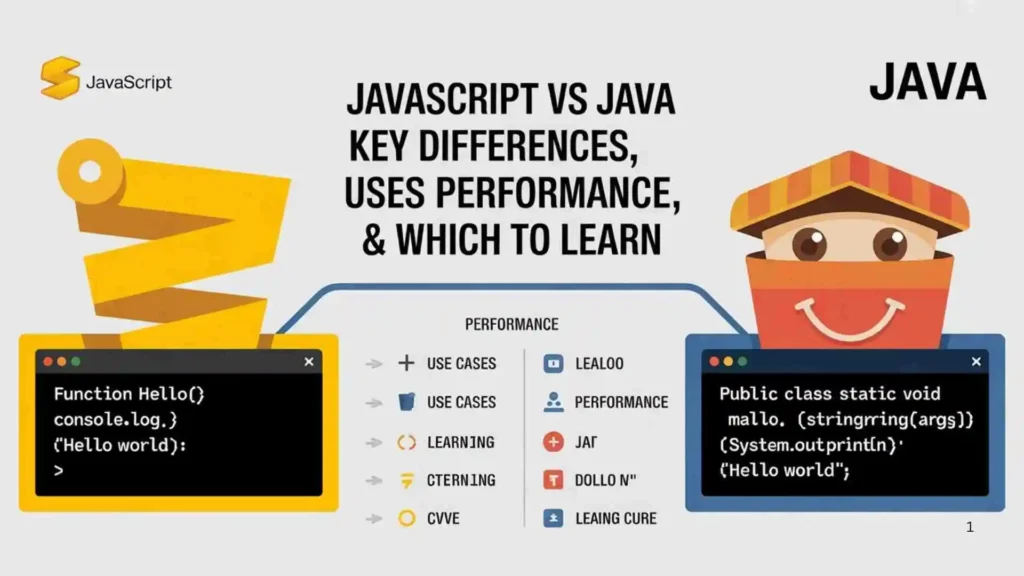
JavaScript is mainly used to create interactive websites, while Java is a powerful language used for building large-scale applications.
Understanding their differences can help you choose the right language for your goals and career.
What Is JavaScript?
JavaScript is a lightweight, dynamic programming language primarily used in web development.
Key Features:
- Runs in web browsers
- Enables interactive web pages
- Easy to learn for beginners
- Supports front-end and back-end (via Node.js)
It is essential for modern web development.
What Is Java?
Java is a robust, object-oriented programming language designed for building large-scale applications.
Key Features:
- Platform-independent (Write Once, Run Anywhere)
- Strongly typed language
- Used in enterprise and Android development
- High performance and scalability
It is widely used in professional software development.
JavaScript vs Java: Key Differences Explained
Syntax
- JavaScript: Flexible and dynamic
- Java: Strict and structured
Performance
- JavaScript: Faster for small web tasks
- Java: Better for large, complex systems
Platform
- JavaScript: Runs in browsers
- Java: Runs on the Java Virtual Machine (JVM)
Learning Curve
- JavaScript: Easier for beginners
- Java: Requires more time to learn
Use Cases of JavaScript
- Web development (front-end)
- Interactive websites
- Mobile apps (React Native)
- Server-side apps (Node.js)
Use Cases of Java
- Enterprise applications
- Android app development
- Backend systems
- Banking and financial software
Pros and Cons of JavaScript
Pros
- Easy to learn
- Highly versatile
- Large community support
Cons
- Security concerns
- Browser compatibility issues
Pros and Cons of Java
Pros
- High performance
- Secure and reliable
- Strong ecosystem
Cons
- More complex
- Requires more memory
JavaScript vs Java: Which Is Better to Learn?
Choose JavaScript if:
- You want to build websites
- You are a beginner in programming
Choose Java if:
- You want to work in enterprise development
- You are interested in Android apps
Your choice depends on your career goals.
Career Opportunities
Both languages offer strong career paths:
- JavaScript: Web developer, front-end developer
- Java: Software engineer, backend developer
Demand for both skills remains high in the tech industry.
FAQs
Is JavaScript the same as Java?
No, they are completely different programming languages with different uses.
Which is easier to learn?
JavaScript is generally easier for beginners.
Which has better performance?
Java performs better for large-scale applications.
Can I learn both?
Yes, many developers learn both languages.
Which is better for jobs?
Both have strong job opportunities depending on your career path.
Conclusion
The JavaScript vs Java comparison highlights two powerful but very different programming languages.
JavaScript is ideal for web development and quick learning, while Java is best for building large, scalable applications.
Choosing the right language depends on your goals, but both offer excellent career opportunities and long-term growth.
Also Check These Posts
- Double vs Float What’s the Real Difference in Programming for 2026
- Flask vs Django Which Python Framework Should You Choose for 2026

Sophia Miller
Hi, I’m Sophia Miller, a passionate language enthusiast and grammar lover. Ever since I was a child, I’ve been fascinated by the power of words and how proper grammar can transform communication. I’ve spent years exploring the intricacies of English, from punctuation quirks to sentence structures, and I love helping others master the art of writing clearly and confidently. Writing, teaching, and sharing tips has always been my way of connecting with fellow language lovers. When I’m not analyzing sentences, you’ll find me reading novels or sipping coffee while jotting down new ideas. Grammar isn’t just rules to me—it’s a way to express creativity with precision.
Books by Sophia Miller:
-
Mastering English Grammar Made Easy
-
The Writer’s Guide to Perfect Sentences